

By combining SEO, AEO, content ops, and outside authority sources to improve Asana’s visibility in AI-generated answers, the program drove real, measurable growth in qualified enterprise demand within six months.
|
Key performance indicators
|
Challenge: Asana’s substantial organic presence did not extend to AI search
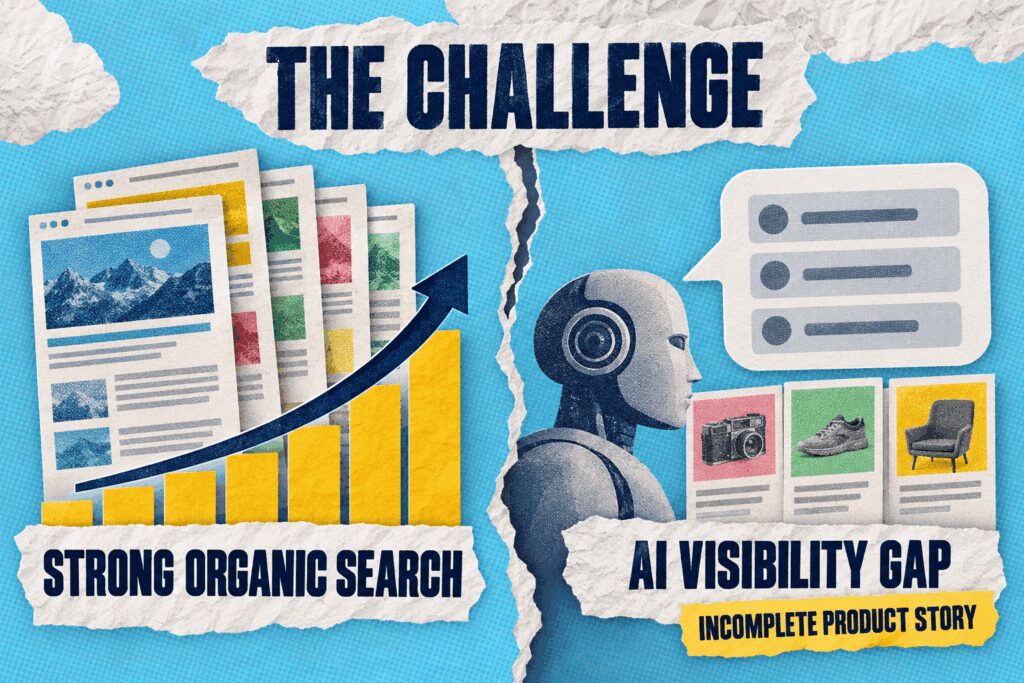
Organic search has consistently attracted new users to Asana. Thousands of product, use-case, template, and resource pages draw individuals seeking project management information each day.
However, the way prospects search for solutions has changed.
Marketing leaders, operations teams, PMO directors, and IT buyers increasingly use ChatGPT, Claude, Gemini, and Perplexity to obtain platform recommendations, compare vendors, and seek advice on AI in project management.
Prospects asked AI questions like:
- Which project management platform works best for enterprise teams?
- What are the best Asana alternatives?
- How does Asana compare with Monday.com, ClickUp, and Smartsheet?
- Which tools offer AI agents for project management?
- Can Asana support an enterprise PMO?
- What project management software integrates with Salesforce and Jira?
Asana ranked well on Google, but its authority didn’t always carry over to AI-generated answers. Large language models often referenced outdated comparisons, old Reddit threads, review sites, and legacy descriptions of Asana.
AI tools often recommended competitors for features that Asana already offered. Some answers described Asana only as a task-management tool, rather than as a full enterprise work-management and AI platform.
The team also faced a crowded and rapidly evolving AEO market. Every week brought new advice, like adding more FAQs, updating schema, creating an llms.txt file, posting on Reddit, rewriting intros, or monitoring numerous loosely defined prompts.
The company needed a systematic approach to identify which tactics improved citations, qualified discovery, and sales pipeline.
Enterprise buyers posed another challenge. They wanted detailed information on security, governance, integrations, implementation, AI features, and business outcomes. Generic, AI-generated content didn’t meet their needs.
Solution: We launched an enterprise SEO and AEO program within a few months
I developed a cross-functional initiative that integrated AI visibility, traditional search, content operations, technical SEO, and performance attribution.
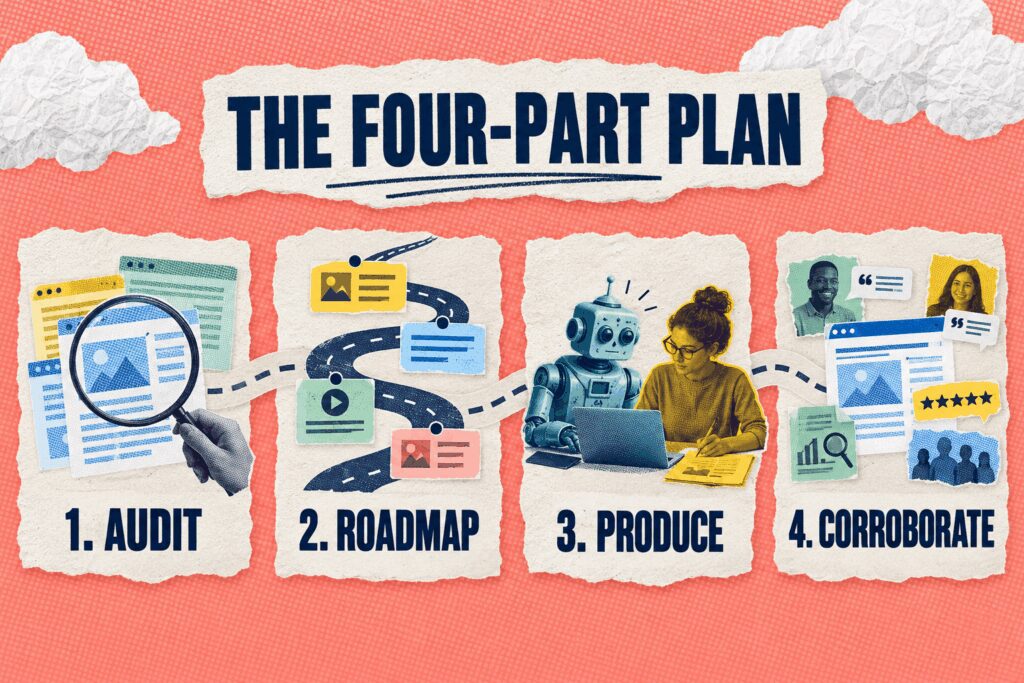
1. Audit and diagnosis
During this phase, my role was diagnostic. I audited Asana’s technical SEO, content performance, competitors, and AI search visibility, then documented my findings and shared recommendations for the SEO team to address.
I used four primary auditing tools:
- I crawled the site using Screaming Frog to spot indexability issues and other technical problems.
- I used Google Search Console to compare crawl results with actual index and performance data.
- I checked keyword performance and competitor gaps using Ahrefs to estimate the search and business impact of each issue.
- I used Profound to benchmark Asana’s mentions, citations, and share across top AI answer engines.
For every recommendation, I identified which subfolders, page groups, or marketing materials needed optimization and identified new hub-and-spoke pages to produce. I also documented the evidence for each problem, explained its impact, and outlined who would fix it and how we’d confirm it was resolved.
What my site audit uncovered:
- Indexation inconsistencies in international sections
- Overlapping product, features, educational, and use-case pages
- Weak internal links between educational and commercial content
- Legacy product descriptions and out-of-date pages
- Important information hidden inside interactive modules
- Inconsistent schema and metadata
How my AEO and GEO audit works
For the AEO portion, I grouped buyer prompts by company type, team, industry, and use case, then compared that demand with Asana’s existing content.
The research revealed recurring questions that broad product pages couldn’t answer well; for example, how agencies manage client work, how operations teams handle project intake and resource planning, or how regulated industries coordinate complex work. I translated these gaps into a content roadmap for dedicated audience and workflow pages.
How I use Profound
Using Profound, I compared how often Asana and competitors like Monday.com, ClickUp, and Smartsheet appeared in answer engines. I looked at which sources were cited, how each platform was described, and where competitors were credited for features that Asana also provided. This analysis helped me identify gaps and plan our next steps.
The initial benchmark found that Asana appeared in only 11% of unbranded enterprise recommendations. Answer engines often credited competitors for enterprise capabilities, integrations, and AI features that Asana also offered, but left our tool out of the conversation.
I presented a prioritized action plan with supporting evidence to the SEO team, addressed stakeholder questions, and delivered implementation recommendations.
2. Planning and roadmapping
The audit showed Asana didn’t need another generic pillar-and-cluster plan. It needed a product-led content system that answered buying decisions from four angles: 1) the work a buyer needed to do, 2) the team doing it, 3) the industry context, and 4) the type of organization adopting the platform.
- Use cases (/uses): Each page focused on a key workflow or job, explained how Asana supports it, connected features to real steps, and answered common buyer questions. For example: goal management, strategic planning, and AI task management.
- Teams (/teams): Each page showed how Asana supports teams like Marketing, IT, and Sales with examples of their real workflows and needs, rather than a generic overview.
- Industries (/industry): Pages included industry-specific solutions, language, and examples for sectors like government and healthcare, pairing product features with relevant workflows and requirements.
- Company types (/enterprise, /small-business, /nonprofit, and /agencies): Pages addressed needs based on company size and type. For example, enterprise focused on security and governance, small-business on quick adoption, and nonprofit on mission delivery.
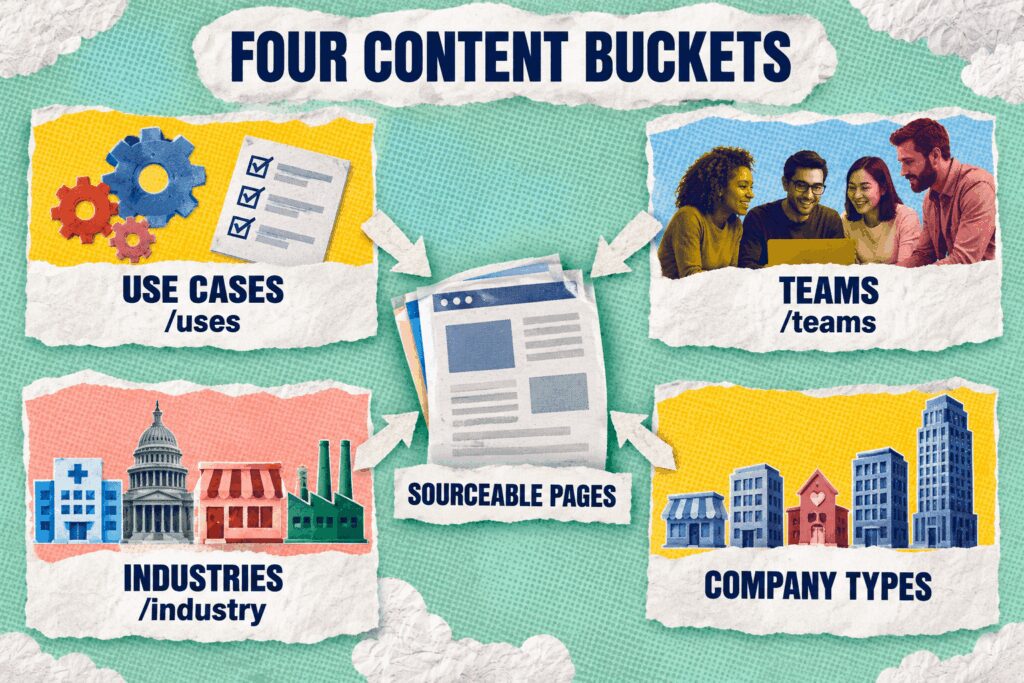
Collectively, these hubs addressed four key questions throughout the site: What work does Asana support? Which teams use it? In which operating environment? At what organizational scale?
We also needed to update educational content
Alongside the new-page roadmap, I developed a refresh plan for Asana’s /templates and /resources libraries. I prioritized pages based on organic performance, search demand, business value, product accuracy, and citation potential, then assigned each URL to either an SEO and AEO rewrite or retirement.
This backlog became the primary input for the AirOps workflow described in the next phase. The team used it to scale SEO and AEO updates, while editors fact-checked and updated content as needed before republishing.

Days 1–30: Map demand to the site architecture
I began by mapping priority keywords, buyer prompts, competitor citations, sales questions, and existing URLs to the four content categories. This process identified where Asana required a new page, a significant rebuild, or additional coverage. It also separated pages that competed for the same intent and assigned each question to a single primary destination.
Days 31–60: Build sourceable pages
We prioritized creating and refreshing the highest-value pages.
Each brief required:
- Direct definitions, descriptive headings, and self-contained answers
- Product facts and workflow examples
- Comparison context and customer proof
- FAQs and structured-data recommendations
- Conversion paths
Product marketing and subject-matter experts verified all claims, while editors ensured each passage still made sense when an answer engine parsed and extracted it.
Days 61–90: Connect and test the content system
We linked hub-and-child pages to:
- Templates and resource articles
- Product documentation and integration pages
- Customer stories
- Comparison pages
We used internal links to connect both net-new and newly optimized content to each buyer group, their workflows, the product features they needed, and the evidence supporting our claims.
We then used Profound to track prompts in ChatGPT, Claude, Gemini, Perplexity, and Google AI Overviews. We compared:
- Citations, mentions, and brand descriptions
- Recommendation share
- Referral quality
3. AI-assisted, human-owned content production

AirOps provided the execution layer needed to scale the roadmap into published pages. While I did not configure AirOps or its integrations, I collaborated closely with Asana’s and AirOps operations teams to define system requirements, test early versions, diagnose recurring issues, and manage the workflow.
How we set up the AirOps workflow
Instead of sending a single large prompt to a model, we divided production into a sequence of controlled AirOps steps. Each run carried structured inputs and outputs forward as variables. AirOps Grids enabled us to apply the same workflow to a queue of URLs while retaining row-level inputs for each page. Human-review gates paused the process wherever editorial, product, legal, or brand judgment was required.
The content production workflow included:
- Structured inputs: Every row identified the target URL, page type, primary keyword, buyer prompts, audience, team, industry or company type, conversion goal, and required CMS modules.
- Grounded source set: We trained the workflow on approved product documentation, brand and style guidelines, existing copy, competitor research, customer evidence, internal link targets, and the content brief to ensure that generation did not rely on generic knowledge.
- Step-by-step drafting: Separate steps created the outline, direct answers, definitions, feature sections, use cases, proof points, FAQs, metadata, and linking recommendations. This modular approach made it easier to correct one part without regenerating the entire page.
- Retrieval and quality checks: Rules verified required sections, unsupported claims, duplicate ideas, keyword overuse, response length, product terminology, source coverage, and whether passages were coherent when extracted from surrounding copy. Conditional steps flagged or rerouted weak outputs.
- Human-review gates: A human in the loop always checked the content before it moved forward. The process paused until someone made edits or gave it the green light.
- Batch execution and handoff: We used Grids to run approved workflows across page queues, compare outputs by row, and organize copy as CMS-ready fields for staging.
My role centered on the editorial and search logic. I translated SEO and AEO strategy into page blueprints, required inputs, prompt targets, source rules, acceptance criteria, and examples of successful output. I also documented CMS constraints to ensure the workflow produced components the production team could stage.
How we iterated the workflow
During testing, I reviewed pages and identified patterns such as repetitive introductions, duplicated headings, vague product language, missing evidence, invented claims, incorrect internal links, and copy that did not align with CMS elements.
I collaborated with the teams to configure AirOps, adjusting prompts, source context, step order, conditional rules, and review gates. Once the workflow met our editorial standards, I prioritized the queue, assigned reviews, tracked revisions, and managed daily production.
Ultimately, we built a system that automates research, drafting, and staging, allowing team members to focus on strategy, product accuracy, and understanding customer needs.
4. Third-party authority
Answer and generative engines rarely relied on a single Asana page when comparing work-management platforms. They combined product claims with customer reviews, videos, long-form expert content, and community discussions. I partnered with content marketing and PR to develop a plan to address the same buyer questions everywhere, both on the Asana domain and marketing channels.
- Customer stories: We produced and shared Asana customer stories that included detailed workflows, specific product features, implementation examples, and detailed results. For instance, Morningstar highlighted how they used AI to streamline intake and content operations, while Indeed shared their experience managing global creative operations. We linked these stories throughout the Asana domain to FAQs, product and feature pages, sales materials, and educational content. In most cases, customers shared those stories on their distribution channels.
- Reddit communities: We monitored r/Asana, r/projectmanagement, and r/productivity for recurring setup questions, product comparisons, complaints, and misconceptions. When Asana employees participated, they disclosed their affiliation, answered questions directly, linked only when an Asana source was genuinely helpful, and avoided coordinated promotion. I fed repeated questions and terminology into briefs, FAQs, video plans, and webinar topics to ensure owned content addressed customer concerns in their language.
- Original research and PR: I coordinated with Asana’s PR team to turn original workplace research into evidence journalists, analysts, and answer engines could cite. The Work Innovation Lab surveyed thousands of knowledge workers for the Anatomy of Work Global Index, State of Work Innovation, and State of AI at Work, while focused studies such as State of Marketing Collaboration and AI Brain Boost explored specific teams and workflows. The PR team turned the findings into media pitches and executive commentary, and I integrated the strongest data points into relevant /team, /industry, /uses, and product pages.
- G2 reviews: I coordinated with our customer marketing team to keep Asana’s G2 profile up to date with categories, feature details, screenshots, and product information. We encouraged real customers to leave honest reviews and monitored both positive feedback and any concerns that came up. Whenever someone had a question, we gave straightforward, factual answers. The words and phrases customers used in their reviews also gave us valuable insight into how they talked about enterprise adoption, integrations, reporting, and day-to-day use.
The goal was to corroborate how Asana solved problems, rather than repeat the same information ad nauseam. Customer stories, videos, and webinars provided verified first-party evidence, while G2 and Reddit showed how customers and practitioners described the product independently.
I tracked which pages and details popular AI platforms mentioned and how they described Asana. When new topics or details emerged, I added relevant content and updated any outdated information at the source.
5. Measurement: Connecting visibility with pipeline
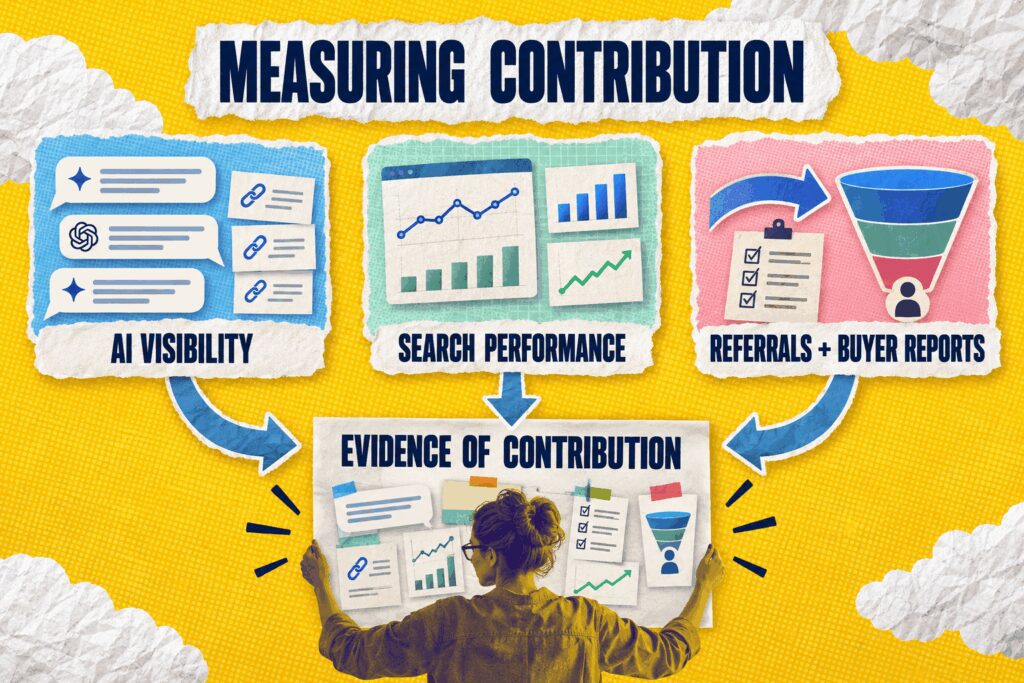
AI search rarely provides a complete attribution trail. A buyer might encounter Asana in an AI-generated answer, watch a video, later search for the brand, and visit the site directly. We therefore triangulated contribution using multiple forms of evidence rather than attributing every opportunity to a single click.
How I track AI visibility in Profound
We used Profound’s Answer Engine Insights to track buyer prompts through major answer engines. We organized those prompts by topic, audience, funnel stage, and platform, then tracked:
- Visibility and share of voice: How often Asana appeared and how its presence compared with competitors.
- Mentions and citations: Which prompts mentioned Asana, which sources supported the answer, and which Asana URLs earned citations.
- Positioning and sentiment: How answer engines described Asana, including the use cases, audiences, strengths, and limitations they associated with the product.
- Competitive gaps: Where answer engines recommended another platform or cited a competing source instead of Asana.
Because AI responses vary between runs, we focused on rolling trends and sustained progress rather than isolated gains.
Reporting and using AI search data
We combined Profound’s visibility data with Google Search Console, analytics, and CRM data to track whether AI search visibility contributed to discovery and demand.
For each topic and page, we reported:
- Mentions, citations, share of voice, and competitor visibility
- Impressions, clicks, queries, and branded search activity
- Organic traffic, engagement, and conversions
- Identifiable AI referrals and buyer-reported AI discovery
If a page picked up new citations in Profound and saw more impressions or clicks in Google Search Console, we took that as a sign it was getting discovered more easily, but not as direct proof that AI search was the only reason. We tracked visibility and search trends each week, then reviewed how those trends related to leads and revenue each month. This helped us prioritize topics without overstating what the data could prove.
Results: Better AI visibility and measurable contribution to enterprise demand
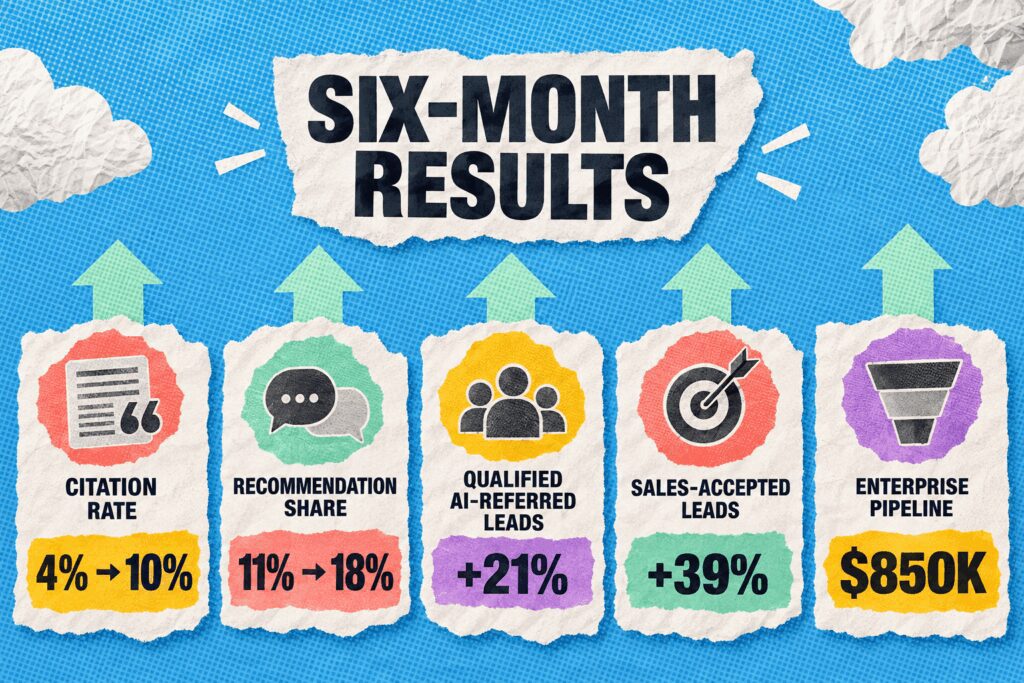
The team published the first priority pages within three weeks. Over the next six months, Profound recorded sustained improvements in how often answer engines mentioned, cited, and recommended Asana. Analytics, CRM data, and buyer-reported discovery also indicated growth in qualified demand with identifiable AI touchpoints.
- Asana’s citation rate across the fixed prompt set increased from 4% to 10%.
- Its share of unbranded enterprise recommendations increased from 11% to 18%.
- Qualified AI-referred leads increased by 21%.
- Sales-accepted leads with a documented AI touch increased by 39%.
- Opportunities with an identifiable or buyer-reported AI touch generated $850,000 in enterprise pipeline.
Profound also revealed a shift in how answer engines described the company. More tracked responses associated Asana with enterprise work management, portfolio management, workflow automation, and agentic AI, rather than only task management.
The pipeline figure reflects opportunities where referral or buyer-reported data documented an AI interaction. It does not attribute the full value of those opportunities to AI search alone.
Beyond these initial gains, the program provided Asana with a repeatable operating model for auditing AI visibility, prioritizing opportunities, producing sourceable content, and measuring progress as the channel evolved.
Ready to turn AI search into an acquisition channel?
The Asana program showed how enterprise AEO can move from an experiment to a measurable source of demand. By connecting technical SEO, buyer-prompt research, sourceable content, internal linking, third-party evidence, and disciplined measurement, we improved how often answer engines cited and recommended the brand while generating qualified leads and identifiable pipeline. Just as importantly, the project produced a repeatable system that the team could continue testing as AI search evolved.
If your company needs a practical approach to AI visibility, explore my SEO, AEO, and content strategy services or get in touch to discuss your project. And if this case study gave you something useful, share it, cite it, or link to it. Those signals help other marketers find the article while teaching search engines and AI platforms to associate my work with enterprise AEO, AI visibility, and content operations.
Frequently asked questions about enterprise AEO
What is enterprise AEO?
Enterprise answer engine optimization (AEO) is the practice of making a company’s content easier for AI platforms to retrieve, interpret, cite, and use in generated answers. It combines technical SEO, content strategy, structured information, credible evidence, and measurement around commercially important buyer questions.
How does AEO differ from traditional SEO?
Traditional SEO primarily measures rankings, organic traffic, and conversions from search engines. AEO also measures brand mentions, citations, recommendation share, positioning, and referrals from platforms such as ChatGPT, Claude, Gemini, Perplexity, and Google AI Overviews. Both disciplines depend on accessible websites, useful content, authority, and accurate information.
What makes content more likely to earn AI citations?
AI platforms can more readily use pages that provide direct answers, descriptive headings, standalone passages, verified facts, original evidence, and structured data. Strong internal links and accessible product documentation also help answer engines connect claims with supporting information.
How should companies measure AEO performance?
Companies should monitor citation rates, brand mentions, recommendation share, brand descriptions, and referral quality over time. They can combine this information with Search Console, analytics, CRM records, and buyer-reported discovery to estimate AEO’s contribution without assigning every opportunity to a single AI interaction.
How long does it take to see results from an AEO program?
The timeframe depends on publication speed, site authority, technical conditions, and how frequently answer engines revisit relevant sources. In this program, the team published the first priority pages within three weeks and evaluated sustained changes over six months. Citations increased first, followed by measurable growth in referrals and qualified leads.